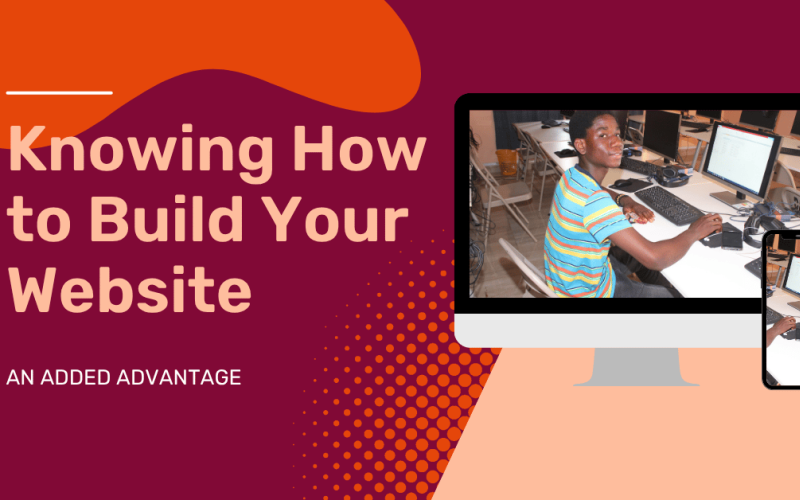
Most organizations have a website. Far fewer control one. The difference shows up the day you need to post an urgent appeal, fix a broken donate button, or launch a new program page, and the only person who can do it is a contractor who answers email on Thursdays.
Knowing how to build a website, and understanding a content management system (CMS) like Drupal, closes that gap. It is not about becoming a full-time developer. It is about owning the most public, most permanent expression of your mission.
After more than 28 years in technology, and years of running Develop Africa's own site, I have come to see web literacy less as a technical skill and more as a leadership one. But I did not start out knowing any of this.
How I learned it: one weekend at a time
Around 2006, I needed a website and started where many people did, with Microsoft FrontPage. It worked until it didn't. Every page was its own island, and keeping a growing site consistent became a chore. Around 2008, I discovered content management systems and realized what I had been missing: an integrated system where content, design, and structure work together.
I chose Drupal. I am not a programmer; the closest I came was a COBOL class. But I could see that Drupal was an enterprise-grade workhorse, capable of handling tens of thousands of pages and taking on any theme. So I gave it my weekends, often five to ten hours at a stretch, reading the forums on Drupal.org, searching for modules, reading about their advantages, installing and testing them, and learning how themes work.
That investment has kept paying off. I began building and maintaining websites for churches and nonprofit organizations, and I still do for a select few. For one church, I set up different themes for different sections within a single site. Most importantly, it lets me keep a close eye on Develop Africa's website. When we recently ran into a wave of spam comments, I nipped it in the bud and cleaned it up immediately, rather than opening a ticket and waiting. I know how to create accounts, configure permissions, and decide who can do what, because I learned it myself.
Here is why I recommend this path to every leader I work with.
1. You remove the bottleneck between idea and publication
When you can build and edit your own pages, the time from "we should say something" to "it's live" drops from weeks to minutes. That speed matters most when it counts: a crisis appeal, a matching-gift deadline, a news story you want to ride.
Independence also changes how you think. Leaders who depend on someone else to publish tend to batch their communication into rare, oversized updates. Leaders who can publish themselves test small ideas, measure what works, and adjust. The website stops being a brochure and becomes a working tool.
2. You own the foundation: domain, DNS, and hosting
Your domain name is the address for both your website and your email. Whoever controls it controls how the world reaches you. Yet in many organizations, nobody on staff can say who holds the registrar login, where the site is hosted, or when the domain renews.
The failure is common and painful. A domain registered years ago under a former volunteer's personal account. A developer who moved on and took the hosting credentials with them. A renewal notice sent to an inbox no one checks. When that happens, the website goes dark and email stops, often at the worst possible moment, and recovering it can take weeks.
Understanding the basics of domains, DNS, and a hosting control panel such as cPanel turns that risk into something you manage. You do not need to run servers. You need to know enough to answer four questions with confidence:
- Is the domain registered in the organization's name, tied to an organizational email address, and set to auto-renew?
- Do at least two trusted people hold the registrar and hosting logins, stored securely?
- Are backups running, and has anyone ever restored one to prove they work?
- Is there a written record of where everything lives, so the next person is not starting from zero?
Whether you learn to manage these yourself or ensure someone accountable does, this is the cheapest insurance an organization can buy. It is also a governance issue, not just a technical one. A board that would never let a single person hold the only key to the office should not accept it for the website.
3. You learn to think in systems, not pages.
A good CMS forces you to ask structural questions. What kinds of content do we actually produce? Programs, stories, reports, events, people? What fields does each one need? How should they be categorized so a visitor, or a funder, can find them?
In Drupal, those answers become content types, fields, taxonomies, and views. That discipline transfers directly to the rest of the organization. If you can model your website cleanly, you can usually model your donor records, your program reporting, and your knowledge base too. Messy websites are often a symptom of messy internal systems, and building one well exposes the mess early.
This is the same principle behind building institutions that endure: structure outlasts individual effort.
4. Drupal rewards organizations that plan to grow
Drag-and-drop builders are fine for a single brochure site. Drupal is built for organizations that expect to have many contributors, many content types, and real accountability. It is the platform of choice for many universities, governments, and large nonprofits for that reason.
What that means in practice:
- Governance built in. Granular roles and permissions let a program officer edit their own pages without touching the donate form or the board documents. Content workflows can require review before anything goes live.
- Structure that scales. Content types, taxonomies, and views let one site serve dozens of programs, countries, or audiences without becoming a maze.
- Multilingual by design. Translation support is part of core, which matters for organizations working across languages and regions.
- Security and longevity. Drupal is open source, has a dedicated security team, and has no licensing fee. You are not renting your platform from a company that can change its pricing or close.
- Integration. It connects to CRMs, payment processors, email platforms, and APIs, so the website can sit at the center of your systems rather than off to the side.
The trade-off is a steeper learning curve. That is exactly why understanding it is an advantage: most people avoid it.
5. You become a smarter buyer
Even if you never write a line of code, understanding how websites work changes every conversation with a vendor. You can tell the difference between a two-hour fix and a two-week project. You can spot a quote padded with work you could do yourself. You can ask whether a feature needs custom development or just a configuration change.
That knowledge protects your budget and your independence. Organizations that do not understand their own site often end up locked into one developer, one hosting plan, or one proprietary theme, paying for every small change. Organizations that do understand it hire help for the hard parts and keep the routine work in-house.
6. Your website is your credibility, and you can protect it
Funders, partners, and donors visit your website before they reply to your email. An outdated program page, a broken link, or a 2019 annual report quietly tells them the organization may not be paying attention.
When you can maintain the site yourself, it stays current. Impact numbers get updated when they change. New partners get recognized promptly. Financial documents and governance information are easy to find, which signals transparency. Over time, a well-kept website does some of the trust-building that used to require a phone call.
7. AI multiplies what you already know
The calculation has changed in the last few years. Once you have a solid Drupal foundation in place, an AI assistant like Claude or ChatGPT can write the HTML and CSS for you. You describe what you want in plain language and get working code back. You paste the HTML into the page and add any CSS to your theme's stylesheet. Spacing, line height, layouts, buttons: the details that used to mean hours of fighting with CSS files now come down to a conversation.
For me, this is the best of both worlds. Over the years I have spent hundreds of dollars on themes and extra modules to get layouts I could not build myself. Now, if a theme has a good structure with the right blocks and content types in place, I can do much of the rest by working editorially with AI.
But notice the order. AI multiplies what you already have. It did not replace my years of learning Drupal; it amplified them. It has shortened my time, expanded what I can accomplish, and reduced my dependence on others. Because I understand how the site is built, I know what to ask for, where the code goes, and when something looks wrong. Someone starting from zero gets far less from the same tool. The foundation you build now is what AI will multiply later.
The honest caveat: knowing how is not the same as doing it all
There is a trap here. A founder who can build the website sometimes becomes the only person who ever touches it. That is not independence; it is a new single point of failure, just with a different name on it.
The real advantage comes from understanding the system well enough to design it so others can run it. Set up roles so staff can publish. Document how pages are built. Hire specialists for security updates, performance, and complex integrations. Your knowledge should make the organization less dependent on any one person, including you.
I think of it as getting from point A to point B. Early on, I found there were limits to what I could do well, so I hired skilled developers through Freelancer.com for the more technical work. Someone with the right expertise could finish in an hour or two what might take me ten or twenty hours to figure out. That is not failure; it is good stewardship of time. Even now, with AI in the mix, I still call on a programmer I work with in India when something is beyond me, and he sorts it out quickly. AI has reduced the need for outside experts. It has not eliminated it. Knowing where your point B is, and who takes it from B to C, is part of the skill.
Where to start
You do not need a computer science degree. You need a few deliberate steps:
- Audit who controls your domain, DNS, and hosting this week, and fix any single point of failure.
- Learn basic HTML and CSS well enough to read and adjust a page, and use an AI assistant to write and explain the code as you go.
- Get editor access to your own organization's site and make one small change a week.
- Spin up a free Drupal test site and build three content types that mirror your real work.
- Map who in your organization should be able to publish what, and set up roles to match.
- Write down how your site is built and where it is hosted, so the next person does not start from zero.
None of this happens without a cost, and the cost is time. Set aside the weekends. Step away from social media for a few hours. There are more tutorials available than ever, and AI can coach you through the code. Website skills are not going away, and in an AI-driven world, what you know is exactly what gets multiplied.
Your website is often the first place people meet your mission and the last place they check before they give. Understanding how it works is not a technical luxury. It is part of stewarding the organization well.